TARTAROS
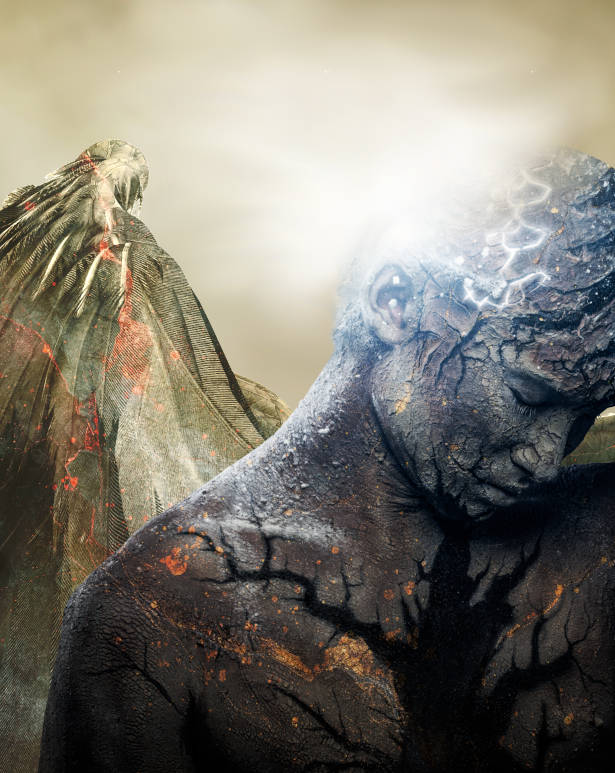
An angel touched by Tartaros, its form breaking under the Darkness
How it Began
Beyond existence lies an eternal nothingness known as Tartaros, or the Darkness, more accurately described as non‑existence. Since the birth of the Spectrum of Existence, it has sought a way in, a way to destroy what is. Scholars and philosophers have long debated what Tartaros actually is, with the more perceptive among them noting the flaw in that question and suggesting it may be better asked as: what is Tartaros not?
Despite differing theories, all agree on one point: whatever Tartaros is or isn’t, it seeks the destruction of all existence. Many now believe the Darkness is not conscious in any mortal or angelic sense, but behaves instinctually — a force of unmaking rather than a thinking entity. This has become the prevailing view among scholars across the world.
The Discovery of the Darkness
The White Daemoni, the imperial holy book, teaches that it was the angels who first discovered the Darkness. When the earliest angels, who were born within the first stars, explored the Spectrum, they eventually reached its edges and found an endless void they could neither touch nor enter. Attempts to cross into it drove some angels insane, while others became ill, describing a deep coldness within them.
Though the White Daemoni does not record every detail, other ancient sources confirm these events. In the end, the angels named the void Tartaros.
A long‑standing theological debate concerns who named the angels themselves. The Imperial Church rejects the existence of gods, insisting angels are divine creators, while others believe angels do not receive names but feel them in ways mortals cannot comprehend.
Volcanus and the First Breach
The first and oldest angel was Volcanus. As more angels were born — thousands becoming hundreds of thousands, becoming myriads — he established a hierarchy with himself at its head. But his thirst for power was not satisfied.
Having created several mysterious angelic artefacts, he forged the first soul shard. Whatever his intentions, what he did is known: he used the shard to cut away pieces of existence, creating the Shathra Stone, then used another part of the Spectrum to form the artefact later known as the Book of Souls, and finally created the Aura.
His original purpose remains unknown, but most scholars agree that he inadvertently began the war between light and dark, between existence and oblivion. By cutting away pieces of the Spectrum, he opened the first breach and allowed Tartaros a way in.
The first attacks came swiftly. Angels vanished from the edges of existence. By the time the threat was understood, it was too late. Tartaros had begun its assault on the Spectrum. Angels gathered at the border to defend it, and myriads were destroyed or turned against their own. It was a catastrophe, and Volcanus was exiled, his name becoming a byword for betrayal among angelic kind.
Shraeds
Tartaros is nothingness, the absence of everything. Yet when it came into contact with the Spectrum, it turned existence against itself. It used the very fabric of existence to form entities, and one of these was the shraed.
Often described as winged monsters, shraeds appear as a dark, writhing mass of talons and wings. They have no independence. They are manifestations shaped by Tartaros to extend its will into the Spectrum. Shraeds spill forth in their millions from vast black holes that erupt within existence. Many scholars believe the first of these ruptures were caused when Volcanus cut away parts of the Spectrum to create his artefacts.
Ranks of angels meet the swarms in terrible clashes of light and darkness. After every battle, the Spectrum shrinks a little more. The angels cannot stop the advance, but they have fought relentlessly to slow it.
Manic and Mania
Manic and Mania are ancient shraeds who slipped Tartaros’ dominion long ago. Born of the Darkness but no longer bound to its hierarchy, they move through the world as a paired anomaly — two minds that speak in interlocking rhythms, two shadows that never quite match. Their duality is deliberate rather than mirrored, a tension that makes them unpredictable even among their own kind.
The Twins delight in manipulation, revelation, and theatrical cruelty. They intervene only when events of greater consequence are in motion, nudging mortals and immortals alike toward outcomes they alone seem to understand. Their motives are never moral and rarely aligned with anyone else.
Appearance
In their chosen guise, Manic and Mania appear almost human. Their proportions are over-dramatic, wrong, their movements a fraction too fluid, and their expressions shaped by imitation not emotion. Manic carries himself with a sharp, amused arrogance; Mania with a languid, predatory grace. Even when they stand still, the air around them feels disturbed, as if reality is adjusting itself to accommodate their presence.
Though they wear mortal forms with unsettling ease, their humanity is not their own. Something of a former host lingers in their expressions and mannerisms — a stolen echo that grants them a depth no other shraed possesses. It is this borrowed spark that makes their facade convincing, and their cruelty strangely intimate. Shraeds are mindless when formed, but Manic and Mania prove that both sentience and independence are possible for such creatures.
When the Facade Drops
When their mortal guise falls away, the Twins reveal what they really are. The illusion of humanity dissolves into a bilious, ethereal presence: vast wings unfurl, twenty feet in length, their feathers formed of shadow and amethyst light. Between those wings, their bodies become a writhing mass of Darkness — black, serpentine strands endlessly consuming and devouring one another, a living storm of shadow without a fixed shape.
Their eyes shift into pale, ovoid voids that regard the world without emotion or mercy. Their movements lose all resemblance to mortal form; they rise effortlessly, pass through stone as though it were smoke, and leave behind a residue of Darkness that clings to surfaces like a stain. In this state, they are unmistakably shraeds — but older, stranger, and more unified than any other of their kind.
And far more dangerous.
The Fallen Ones
(More on these under Angels in the Archive)
While many angels who fell to the minions of Tartaros were destroyed, others were not. Some became Fallen Ones. Infected by the essence of Tartaros, they served as its foot soldiers and often fought alongside the shraeds.
Not all the Fallen were victims. Some chose to change sides for reasons ranging from despair at the onslaught of Tartaros, to disillusionment, to outright hatred of the Seraphim Council. Those who chose their fate often retained their independence of thought and action. Tartaros cared only for the destruction of existence. If that meant some of the Fallen turned on each other or tried to carve out their own territory within the Spectrum, so be it. In the end, the Darkness always wins.
Other Entities of Tartaros
Lucifer
Known as the Prince of Darkness, Lucifer was unusual among Tartaros‑born entities. He possessed a sense of identity that shraeds did not. Even Manic and Mania did not reach his level of sentience without human contact. Lucifer had such contact with a sorceress, though it is unclear whether he drew his identity from her or possessed it beforehand.
At some point he claimed the title of Prince and appeared to rule Tartaros. Little is known about him, but he was clearly more than a mere shraed. He claimed to be Tartaros rather than a product of it, perhaps a manifestation of its will. This may have occurred during the first contact between Tartaros and existence.
The Fetch
Said to have been created by the Grim, though the truth was different. One of the Grim’s titles was Father of Lies, and in this case he merely borrowed the Fetch and shaped it to his needs. The Fetch served because the Grim ultimately served Tartaros, whether he realised it or not.
Tartaros used many servants, willing or unwilling, aware or unaware, to further its aim of annihilation. It often pitted its servants against one another, letting the strongest survive. The Grim was one such servant, though he believed he fought against Tartaros. Perhaps he did at first, but the Darkness had other plans.
Rade Wyn
Born the granddaughter of Imperator Tolan Laman Todralan, her birth name was Rade Wyntara Todralan. She later shortened it. She and her twin sister Antipa initiated the Purges in 702 YC against the viral undead. Even then, they were being used as pawns of Tartaros, which had already marked the undead as a threat.
Though they succeeded in part, Antipa died during the first Purge, and Rade’s son later abandoned her. Left alone, her fate is unclear until 924 YC, more than two centuries later. By then, Tartaros had taken control of her. Only a trace of her humanity remained, enough to resist for a little while longer because of the love she held for her son. By 927 YC, even that was gone.
Nightmares
Nightmares manifested from bodies of water — rivers, lakes, even ponds. They appeared to be made of rotting fish, water grasses, and silt, all held together by dark magic. Their attacks on mortals were devastating. They were extremely difficult to destroy and often required clots of viral mages working together.
Gressil
A personal creation of Lucifer’s. Unlike shraeds, which manifested through simple contact between Tartaros and the Spectrum, Gressil was more of an assassin. It could hide within reflections, reminiscent of the Fetch, and may have been inspired by it.
In its beast form, Gressil had six legs, two heads, and eight mouths filled with teeth. It could also appear in mortal form, though only for limited periods. The reason is unknown. It did not seem to possess identity or independent thought, which proved to be its greatest weakness. It could not adapt or counter complex threats. Tartaros itself struggled to adapt to existence, and its will was often blunted, as with Gressil, or usurped, as with Manic and Mania.
Despite these weaknesses, the threat of Tartaros remains immense. It continues to eat away at the Spectrum piece by piece. Its essence, used to bond with existence and create shraeds and other entities, appears endless. Existence is finite. In a long war, the Darkness wins. Until that day, the fight continues, for struggle is the essence of existence.