Tharaxis (City of the Dead)
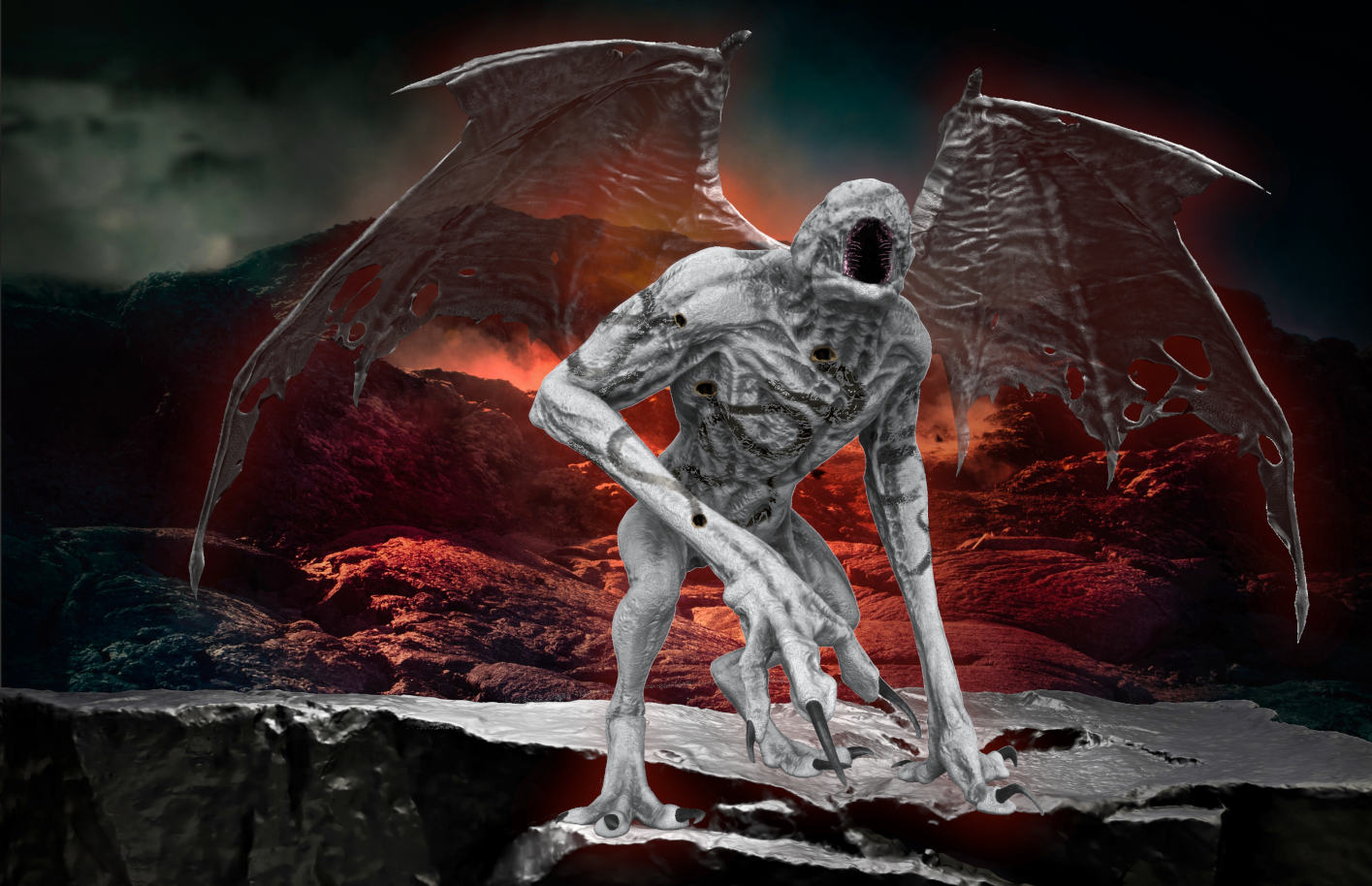
A winged predator of Tharaxis, shaped by griever infection and bound to the eater layer.
Tharaxis occupies a unique position within the Plagueborn world. Readers may approach it as a standalone novella or as a companion to the main series. It also foreshadows creatures, entities and characters that later appear in the World Soul series, though none of this is required for understanding the main storyline. For this reason alone, Tharaxis has been added to the archive as an unusual section of the Plagueborn universe.
Nature of Tharaxis
Despite its title, the City of the Dead as it is otherwise known as, is not a natural afterlife. It is both a mirror‑world and a convergence point within the Spectrum of Existence, where the dead are gathered, held, and hunted. Its architecture suggests a civilisation predating the souleaters, erased so thoroughly that only scattered ruins remain outside the city walls.
The walls themselves rise seamlessly into storm clouds without gates or towers, indicating Tharaxis was never intended for the living, and was constructed after the world’s destruction. It is a containment structure rather than a sanctuary or fortress. It must be noted that even so, some souls with the will to do so, can leave the city, but there is no where to go to, and each and every one of them is drawn back to the city, if they are not hunted down on the plains outside by the souleaters first.
The sky above is a perpetual storm of purple‑black cloud. No sun or moon. Just a diffused glow whose source is unknown. Whatever force destroyed the former civilisation appears to have altered the environment itself too. It is unlikely any living person could now survive there.
It must also be noted that some souls breathe, walk, and behave as though living. This is partly denial, but may also be influenced by the List or some other influence perhaps, as notable souls such as Lorn Larthuz continued to do so long after accepting she was dead. The phenomenon requires further study. Souls, of course, can float and will themselves to move in ways impossible when alive. These abilities appear to manifest once a soul accepts their death.
“The dead do not sleep in Tharaxis. They wait for the hunt to begin.”
Origins of Tharaxis: creation & purpose
The origins of Tharaxis remain a mystery. Its seamless walls and unnatural sky suggest deliberate construction for its current purpose: the containment and harvesting of souls. The city’s dual‑layer structure, consisting of the Soul Layer and the Eater Layer as celestial scholars have come to call them, indicates a metaphysical design beyond mortal or angelic architecture. There seems to be no where else in the Spectrum quite like it.
The eater layer’s existence is perplexing and some scholars argue it was shaped by the Primordial as a breeding ground, with the soul layer acting as a hunting arena. Others believe it is a corrupted mirror of the original Tharaxis, twisted by griever infestation. The truth remains unknown for now.
⸻⟡⸻
Structural Features
Tharaxis exists in two overlapping states as mentioned:
The Soul Layer
This is the layer where the dead exist, clinging to the city’s streets and uninhabited buildings awaiting their fate, with those few who managed to retain memory, seeking out deeper places to hide from the hunters. It should also be noted that these latter souls, attract the souleaters most often, as the creatures appear to enjoy the hunt, often passing up easier prey. Whether this is merely instinctual on the souleaters’ part, or by design, is a topic of debate among scholars.
The Eater Layer
This is where souleaters dwell, crossing into the soul layer to hunt before withdrawing again. It has been surmised that perhaps the creatures cannot dwell beyond their own layer for long, and it must be noted the Primordial has never crossed over into the soul layer. Whether she is unwilling or unable is also an unknown, but it is a prevailing theory among angelic scholars, in particular.
The List of Souls: ledger of the dead
The List is the mechanism by which Tharaxis functions. It is not merely a celestial ledger, but a binding architecture — a metaphysical gravity well that pulls souls into the city upon death and prevents their departure.
The Librarian, a two‑headed entity tied to the Grim and also named Enepsigos, last held the List. Where the Grim had gotten it is a matter of speculation, but it is likely he created it for purposes known only to him. How it passed from the Librarian to the souleaters, however, remains uncertain. Whatever occurred, the souleaters gained partial dominion over the dead, though they never came into full possession of the List. It later remained hidden within the city and continued to draw souls.
It must be noted that not all names appear on the List. Some souls escape through loopholes, bargains, or anomalies. A rare few are too powerful to compel.
⸻⟡⸻
Celestial Interference
The souleaters never truly possessed the List, or if they did, it was brief. Instead, it was concealed within Tharaxis, prompting the Primordial to hunt relentlessly for it, and to eventually devise a plot to draw it to her instead.
The concealment of the List likely occurred when the Librarian became indisposed. The timing is too precise to be coincidence. The Archive records that certain celestial powers have studied Tharaxis and interfered in its history on more than one occasion. One such being is believed to have hidden the List among the souls of the city to keep it out of the Primordial’s reach. It is possible that removing the List entirely was either impossible or too dangerous.
See Angels for more
Souleaters: Predators of the Dead
Souleaters are transmaterial predators. They are not related to shraeds or angels and cannot be considered creations of Tartaros. Their origin is older, tied to the Primordial and possibly to mysterious entities known as Infernals. These latter have only recently come to the attention of angelic scholars and at present, most cannot even agree if they exist.
A souleater stands around nine feet tall, with elongated limbs sheathed in a pale membrane. Its wings are vast and leathery, and its body is filled with worm‑like grievers, each possessing a mouth that erupts through the membrane when feeding. They have no facial features save for a lone gaping maw. It’s through this mouth, and the mouths erupting through its flesh that in hales the souls of its victims.
It has been surmised by some that the devoured souls may leave something of themselves behind within the souleater, but this is pure speculation with little evidence to back it up. However, it is still and interesting and somewhat horrific concept. If true, it must be hoped that such soul remnants have no lingering awareness.
Scholars have also postulated that souleaters may once have been human, transformed over time by griever infestation. Of course, there have been those few among angels with a tendency to blame human mortals for all ills.
“Every soul is a story, and every story is a wound.”
The Fractured: Broken souls
In Tharaxis, after a hunt, the feeding sometimes leaves behind half‑eaten souls known as the Fractured. These remnants leak dirty golden light and wander the city in dangerous, unstable states, drawn to the dead who still behave as though alive.
Why souleaters abandon certain victims mid‑consumption remains unclear. Some scholars argue they feed until sated, leaving behind those they cannot finish, or are distracted by more desirable prey. Once a soul becomes Fractured, it is as though it has become unpalatable — a ruined meal left to rot.
⸻⟡⸻
Metaphysical Anomalies Within Tharaxis
Yaldo’s Exception
The boy Yaldo was caught three times by the predators of Tharaxis. By all known metaphysical laws regarding the City of the Dead, and not to mention souleaters, he should have become one of the Fractured. For some reason, he did not. His angel‑touched nature may have resisted collapse, allowing him to survive partial consumption and retain his identity. This suggests that angelic resonance can stabilise a soul under such catastrophic pressure. It is to be noted that this subject is a point of contention among angelic scholars.
Memory Erosion
Soul memory erodes under several pressures: the binding influence of the List, the predatory presence of the souleaters, distortions of the eater layer, and the unnatural architecture of the city. Some souls resist erosion, likely due to metaphysical anomalies or celestial interference.
The Librarian and the Temple Library
The Librarian’s abode is hidden within Tharaxis — a dark, doorless stone structure whose interior descends into a long tunnel protected by an unseen barrier likely meant to repel souleaters. Once home to Enepsigos, it was a place where the creature snatched souls for its own purposes.
During the events preceding Tharaxis, the Librarian was forcibly removed from its lair by the Shadow Twins. Imprisoned within a memory fragment, it vanished from the city, leaving Tharaxis without its keeper. This destabilised the city’s metaphysical balance and created an opportunity for other forces to intervene.
After the Librarian vanished, the Temple Library became the headquarters of the resistance led by Markus Olen Todralan, former imperator of the Icarthian Imperium, later to be taken over by his daughter, Aiyana.
⸻⟡⸻
Resistance against the souleaters
The resistance formed after the first souleater attacks, believed to have been formed and first led by the soul of Markus Olen Todralan, the former imperator of the Imperium. Its members needed to retain enough memory to organise, and their goal was to sever the souleaters’ control over the dead. This evolved into a hunt for the List of Souls, and the arrival of Lorn Larthuz made that hunt possible. Their knowledge derives from the Librarian’s abandoned records and from Axiom, a sentient shraed sent to guide Lorn.
A brief note on Threadfin Todralan’s visions:
During the events of A Viral Imperium, Threadfin witnessed what he believed were shraedic encounters — souls fleeing winged shadows near Byrsa, and later his father leading a procession of the dead. The Archive now recognises these moments as glimpses of Tharaxis itself. Due to Temporal Disjunction, events within the City of the Dead do not align with mortal chronology; for example, Aiyana was still alive when Threadfin saw Shakti’s ghost, though both were already present in Tharaxis. His interpretation was shaped by the limited knowledge available to him, and these visions illustrate how Tharaxis can bleed unpredictably into the mortal world.
Axiom: shraed, Scholar, Observer
Axiom is one of three known sentient shraeds independent of Tartaros. Unlike most of his kind, he possesses curiosity, humour, and a genuine interest in mortals. His explanations blend observation, improvisation, and instinct, and he frequently invents terminology to describe metaphysical phenomena.
It is understood that he serves Manic and Mania, the Shadow Twins, who appear to have a personal stake in Tharaxis and its inhabitants.
⸻⟡⸻
The Shadow Twins: Manic & Mania
Manic and Mania’s interest in Tharaxis is personal. Though they rarely appear within its walls, their presence is felt through Axiom and, indeed, through Lorn, who is there at least in part because of them.
The Twins show no desire to rule Tharaxis, nor do they openly interfere with its guardians. Their influence is more intimate: a watchfulness, a curiosity, a sense that the city’s mysteries amuse them and that every disturbance within its borders is connected to a longer, unseen design. Axiom’s connection to Tharaxis is understood to come from them, and his guidance often reflects their eccentric priorities.
To the living, the Twins are a rumour. To the dead, they are a disturbance. To Tharaxis itself, they are an omen — a sign that the city’s deeper truths are stirring, and that forces beyond mortal comprehension have taken an interest in what lies beneath its streets.
“Tharaxis does not keep the dead. It devours them!”
Axiom’s Terminology and Metaphysical Studies
Axiom has developed a personal lexicon to describe the metaphysical behaviours of souls and the structure of Tharaxis. Though informal and often self‑invented, his terminology has become useful for categorising strangeness observed within the city. He has a tendency to insist that such studies belong to his “cousins”, but his protestations have remained unconvincing to scholars.
Spectral Thaumaturgy Resonance
Axiom’s term for the imprint of viralic magic upon a soul after death. In Aiyana Todralan’s case, her necromantic thaumaturgy carried over into Tharaxis, allowing her to create illusions with ease. These manifestations are shaped by memory and instinct, and a residual magical echo.
Memorolithics
The ability of a dead soul — typically one who possessed magic in life — to manifest objects through memory, energy, and visualisation. Aiyana demonstrates advanced memorolithics, able to recreate entire environments such as libraries or palace chambers, though the contents remain but hollow echoes.
Temporal Disjunction
Temporal Disjunction refers to the non‑linear arrival of souls in Tharaxis. A person who died a thousand years ago may appear in the city only today, while someone who died yesterday might have already spent centuries there. Death and arrival bear no consistent relationship to one another, and no pattern can be perceived. Cause and effect, sequence, and duration, all appear to lose alignment with mortal chronology once a soul crosses into Tharaxis.
Transmaterial Dynamics
A study of the ability, or sometimes inability, of souls to interact with the mortal world. It includes phenomena such as passing through solid structures, floating, falling, or exerting limited influence on physical matter.
Necromantic Thaumaturgy
The magical discipline associated with the viral undead. In life, Aiyana wielded necromantic thaumaturgy; in death, its echo became spectral thaumaturgy resonance.
Necropsychology
An obscure field concerning the psychological state of souls who struggle to relinquish their former lives. It describes behaviours such as denial, clinging to identity, or the mimicking life.
See Magic for more on viralic and spectralic magic
⸻⟡⸻
Shraeds of Tartaros
Shraeds are the primary manifestations of Tartaros within the Spectrum — dark, winged entities shaped from existence itself when the Darkness forces its way in. Though often perceived as monsters, shraeds are closer to functions than creatures: extensions of Tartaros that act to weaken, sever, or collapse structures of being. They do not think or choose in any mortal sense; they operate according to the instinctive logic of non‑existence.
Rare exceptions exist. When shraeds come into prolonged contact with mortal consciousness, identity can imprint upon them, producing anomalies with independence and personality. The Shadow Twins are the most notorious of these, having absorbed fragments of humanity and developed their own agendas. Axiom represents an even rarer form of sentient shraed, capable of interpretation, negotiation, and self‑directed action while still retaining the underlying logic of Tartaros.
Shraeds therefore occupy a spectrum: most are instinctive extensions of the Darkness, some become corrupted by identity, and a very few become aware.
All, however, remain bound to the fundamental purpose of Tartaros — the slow, relentless unmaking of existence.
See Tartaros for more on shraeds and the Shadow Twins.
⸻⟡⸻
Notable Individuals in Tharaxis
Lorn Larthuz
Lorn arrives in Tharaxis with at least some memories intact. She behaves as though still alive — an anomaly within the City of the Dead. Her Grim‑touched nature grants her resilience against memory erosion and allows her to cross between the two layers of Tharaxis. She becomes central to the resistance’s efforts to retrieve the List and free the souls.
Aiyana Mayala Todralan
Aiyana enters Tharaxis with the same quiet authority she held in life. Once imperatrix of the Icarthian Imperium and sister to Threadfin Todder, she was a viral — undead, yet capable of masking her nature so completely that even other virals struggled to perceive it. This lifelong habit of pretending she was alive shaped her identity more deeply than any imperial title.
Her arrival follows her imprisonment by the Librarian, who held her as payment for information previously given to Threadfin. Her brother forced her release, unaware of the consequences, as all those freed were drawn into Tharaxis to be hunted by the souleaters.
Within the city, Aiyana’s refusal to accept her undead nature manifests again as a refusal to accept death. Having wielded viralic magic throughout her unlife, she carries an echo of that power. Yaldo admires her apparent steadiness, unaware that it is not a gift but the continuation of a habit she never abandoned.
See Virals for more on Aiyana’s true nature.
Yaldo
Yaldo is the most resilient child‑soul in Tharaxis. Angel‑touched, he retains memories far longer than others and shows an unusual resistance to dissolution; Kael lasts as long as he does only because he stays close. Yaldo survived two souleater attacks — the second leaving an infection that began his slow transformation — and once this change took hold, the eater layer grew indifferent to him, treating him less as prey and more as something becoming its own. He clings to fragments of a family he may or may not have had, and the act of pretending keeps him whole. After befriending Aiyana, he becomes one of the youngest members of the resistance, carrying within him the hidden List of Souls that draws the Primordial’s attention.
Cosmological Significance
Tharaxis stands alone within the Plagueborn saga, yet its cosmology — the nature of souls, the dual‑layered structure of reality, and the origins of the souleaters — echoes through the Spectrum. The forces that shaped it are older than angels or shraeds, and much older than mortals. Hints also suggest the souleaters may be part of a group of entities known as Infernals or at least in some way connected to them. Whether the Primordial is also one of these or created by them remains a mystery.
Beyond Tharaxis
The City of the Dead is, of course, not the end. It is the beginning of a mystery that will continue to unfold in the World Soul series.
For more on the World Soul series, visit Darren’s Worlds